Guide
How much mulch do I need?
Figuring out how much mulch to buy comes down to one chain of math: measure the bed, pick a depth, and convert to cubic feet, cubic yards, and bags. This guide walks through that math, shows how depth changes the order, and explains bags versus bulk so you order a planning estimate instead of guessing.
Worked example — mulch takeoff
| Bed | 20 ft × 8 ft | 160 sq ft |
|---|---|---|
| Depth | 3 in ÷ 12 | 0.25 ft |
| Volume | 160 × 0.25 | 40 cu ft |
| Bulk order | 40 ÷ 27 | ≈ 1.5 cu yd |
| Bags | 40 ÷ 2 cu ft | 20 bags |
The area-by-depth math for mulch
Every mulch estimate starts the same way: area times depth. Measure the bed length and width in feet and multiply them for square feet. Pick a depth in inches and divide by 12 to turn it into feet. Multiply the square footage by that depth in feet for cubic feet, then divide by 27 for cubic yards, since one cubic yard is 27 cubic feet. That chain handles any bed.
The worked example and the waste allowance
Here is a worked example. A 20 ft by 8 ft bed is 160 square feet. At 3 inches deep, that is 0.25 ft of depth, so 160 times 0.25 is 40 cubic feet. Divide by 27 and you get about 1.5 cubic yards before any waste. With common 2 cubic foot bags, 40 divided by 2 is about 20 bags. Those are the numbers you take to the supplier.
Treat the result as a planning estimate, not an exact order. Real beds have uneven ground, soft edges, and settling, so most people add a small waste allowance on the base volume. The mulch calculator runs this chain, adds waste, and rounds bag counts up so you do not come up short.
How deep should mulch be by use?
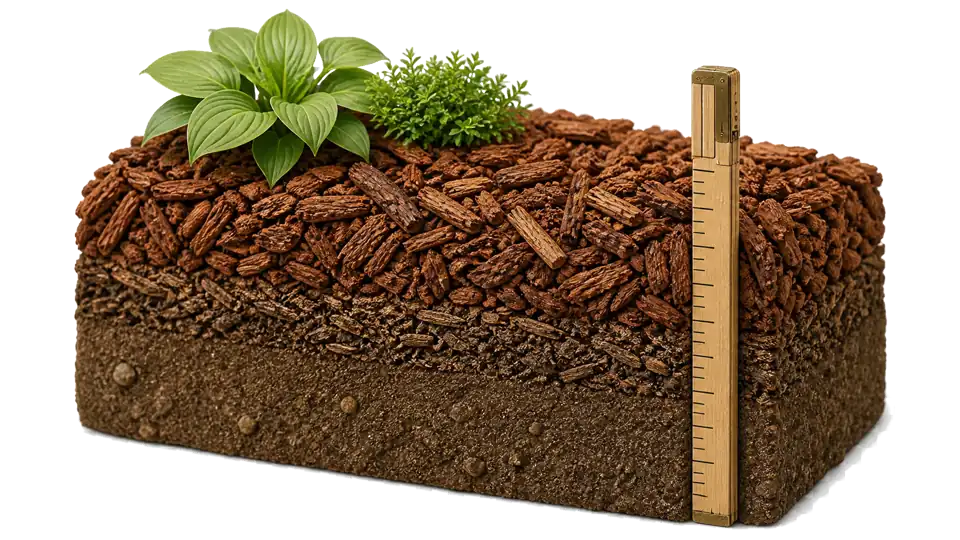
Depth depends on the job. For a yearly refresh over mulch that is already there, about 2 to 3 inches of new material is a common planning depth, and you measure only the new layer, not the full target. The old mulch underneath still counts, so a refresh rarely needs a full new bed's worth.
- 2–3 in
- Yearly refresh — measure only the new layer
- 3–4 in
- New bed on bare soil
- 2–3 in
- Tree ring, pulled back off the trunk
New beds, thin layers, and tree rings in detail
For a brand-new bed on bare soil, 3 to 4 inches is typical. That depth shades out weeds and holds moisture without being so thick it traps water against stems. Thinner than 2 inches lets weeds through and dries out fast, while much deeper than 4 inches wastes material and can smother roots over time.
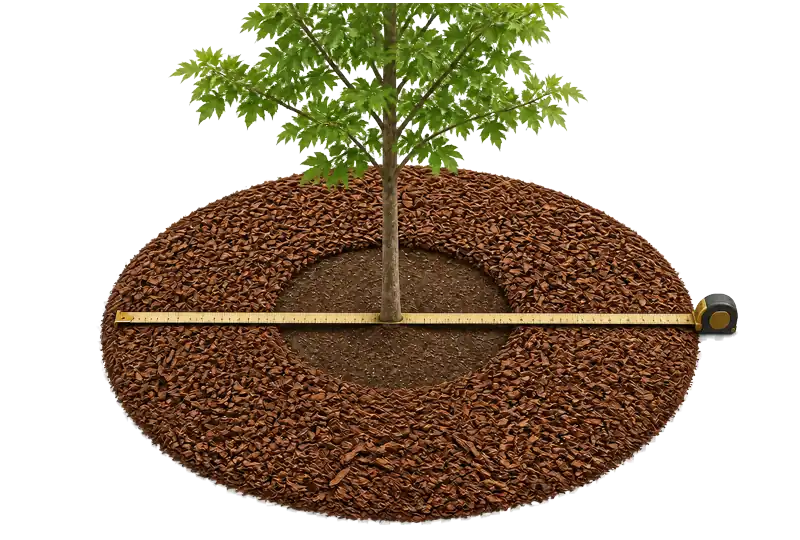
Around trees, keep mulch off the trunk. Spread an even 2 to 3 inch ring and pull it back from the bark instead of piling it into a cone, which traps moisture and invites rot. For a ring, measure the outer and inner diameters so you are not buying mulch for the bare circle you are not covering.
Bags versus bulk: counting your order
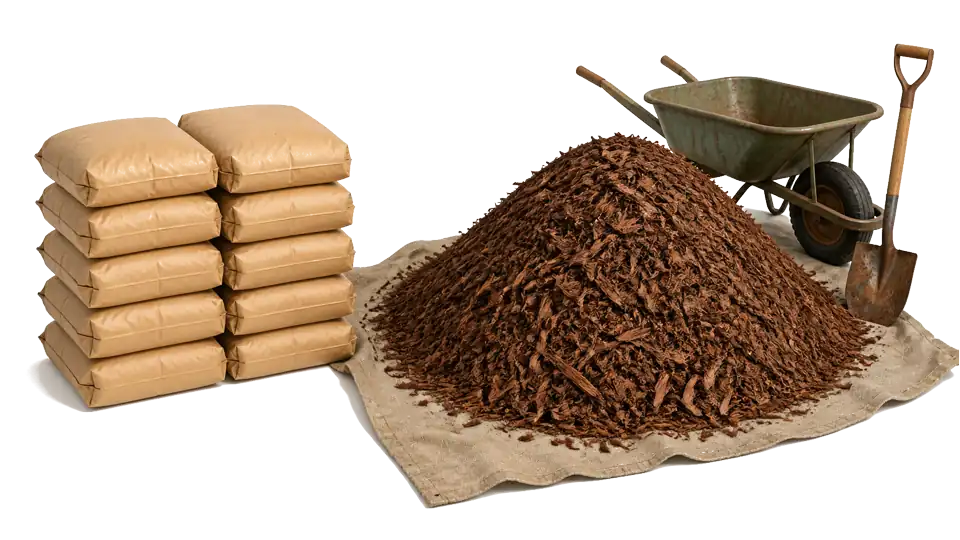
Mulch is sold two ways: bagged by the cubic foot and bulk by the cubic yard. A very common bag holds 2 cubic feet. Since one cubic yard is 27 cubic feet, a cubic yard equals about 13.5 of those 2 cubic foot bags. That ratio is the quick way to see when a job crosses from a bag project into a bulk delivery.
- ≈ 13.5 bags
- One cubic yard in common 2 cu ft bags
- 2–3 cu yd
- Where many orders cross from bags to bulk
When bags stop making sense
Bags suit small beds, tight access, and projects spread over a few weekends. Bulk is usually cheaper per yard for larger areas, but it needs a spot for the pile and a plan to move it before it heats up or sheds color. Many switch to bulk around two to three cubic yards, where 30-plus bags stops making sense.
When you compare prices, count more than the unit cost. Include delivery fees, the bag count, and the labor of hauling and spreading. The mulch calculator shows cubic yards and a bag count side by side, so the crossover between bags and a bulk load is easy to spot before you buy.
Coverage by depth: one cubic yard
Because volume is fixed but you can spread it thick or thin, one cubic yard covers very different areas depending on depth. At 1 inch deep, a cubic yard covers about 324 square feet. At 2 inches it covers about 162 square feet, at 3 inches about 108 square feet, and at 4 inches about 81 square feet. The deeper the layer, the less ground each yard covers.
Why depth drives the order more than area
This is why depth drives the order more than people expect. The same 160 square foot bed needs about 27 cubic feet at 2 inches but about 40 cubic feet at 3 inches, a jump of nearly half a yard. Near a bag or delivery threshold, checking the depth first can save a second trip.
For a quick gut check, divide your square footage by the coverage figure for your depth to estimate cubic yards. A 300 square foot bed at 3 inches is roughly 300 divided by 108, or about 2.8 cubic yards. The calculator does this precisely and adds waste, but the table is handy for a fast sanity check.
Mulch types in brief
Most beds use organic mulch: shredded hardwood, bark nuggets, pine straw, or dyed mulches. They break down over a season or two, feed the soil, and need refreshing as they thin. Shredded hardwood knits together and stays on slopes, nuggets drain freely but float in heavy rain, and colored mulches hold their look longer but weather differently.
Rubber mulch and how bag sizes differ
Rubber mulch is a different product made from recycled tire material. It does not break down, so it does not need yearly refreshing, and it is common for playgrounds and play areas. Its bags are often smaller than wood mulch bags, around 0.8 cubic feet, because rubber is heavy, which changes the bag count for the same volume.
The volume math is identical for both: area times depth, then convert to cubic feet, cubic yards, and bags. Only the bag size and the refresh schedule change. For wood mulch beds and tree rings, use the mulch calculator; for play areas and rubber, the rubber mulch calculator applies the smaller bag size so the count comes out right.
When to switch to the calculator
This guide gives you the math and the depth choices, but a calculator handles the parts that are easy to get wrong: adding a waste allowance for settling and uneven beds, matching your bag size, and rounding bag counts up so you do not run short. It also keeps cubic yards and bags together, where the bulk-versus-bag decision is actually made.
What the calculator adds to the hand math
Reach for the mulch calculator once you have a measured bed and a target depth. Enter length, width, depth, waste, and bag volume, and it returns cubic feet, cubic yards, a bag count, coverage at your depth, and a printable material list for the supplier or a bulk order.
For playgrounds and play areas using recycled tire mulch, use the rubber mulch calculator, since it defaults to the smaller rubber bag size. Either way, treat the output as a planning estimate, and confirm bag size and bulk pricing with your supplier, since those vary by product and location.
Run the numbers with a calculator
You have the math and the depth. Let a calculator add the waste allowance, match your bag size, round bag counts up, and print a material list for the supplier.
Mulch quantity FAQ
How much mulch do I need for a 20 by 8 foot bed?
A 20 by 8 ft bed is 160 square feet. At 3 inches deep that is 160 times 0.25, or 40 cubic feet, which is about 1.5 cubic yards or roughly 20 of the common 2 cubic foot bags before waste. The mulch calculator adds a waste allowance and rounds bags up for you.
How many bags of mulch are in a cubic yard?
One cubic yard is 27 cubic feet. With the common 2 cubic foot bags, that is about 13.5 bags. With 1.5 cubic foot bags it is about 18 bags, and with rubber mulch bags near 0.8 cubic feet it is more. Enter your bag size in the calculator and it rounds up.
How deep should mulch be?
About 2 to 3 inches for a yearly refresh over existing mulch, and 3 to 4 inches for a new bed on bare soil. Around trees, keep an even 2 to 3 inch ring pulled back off the trunk. Measure only the new depth you are adding, since old mulch underneath still counts.
How much does one cubic yard of mulch cover?
It depends on depth. One cubic yard covers about 324 square feet at 1 inch, 162 square feet at 2 inches, 108 square feet at 3 inches, and 81 square feet at 4 inches, all before waste. Deeper layers cover less ground per yard, which is why depth drives the order.
Should I buy bagged or bulk mulch?
Bags suit small beds and tight access, while bulk is usually cheaper per yard for larger areas but needs a spot for the pile and labor to spread it. Many people switch to bulk around two to three cubic yards. The calculator shows yards and bag count together so the crossover is clear.
How do I figure mulch for a tree ring?
A ring is the outer circle's area minus the inner bare circle. Measure the outer and inner diameters, find each circle's area with pi times the radius squared, and subtract. Then apply your depth as usual. Keep the mulch pulled back off the trunk rather than piled against the bark.