Reference chart
Cubic yard coverage chart
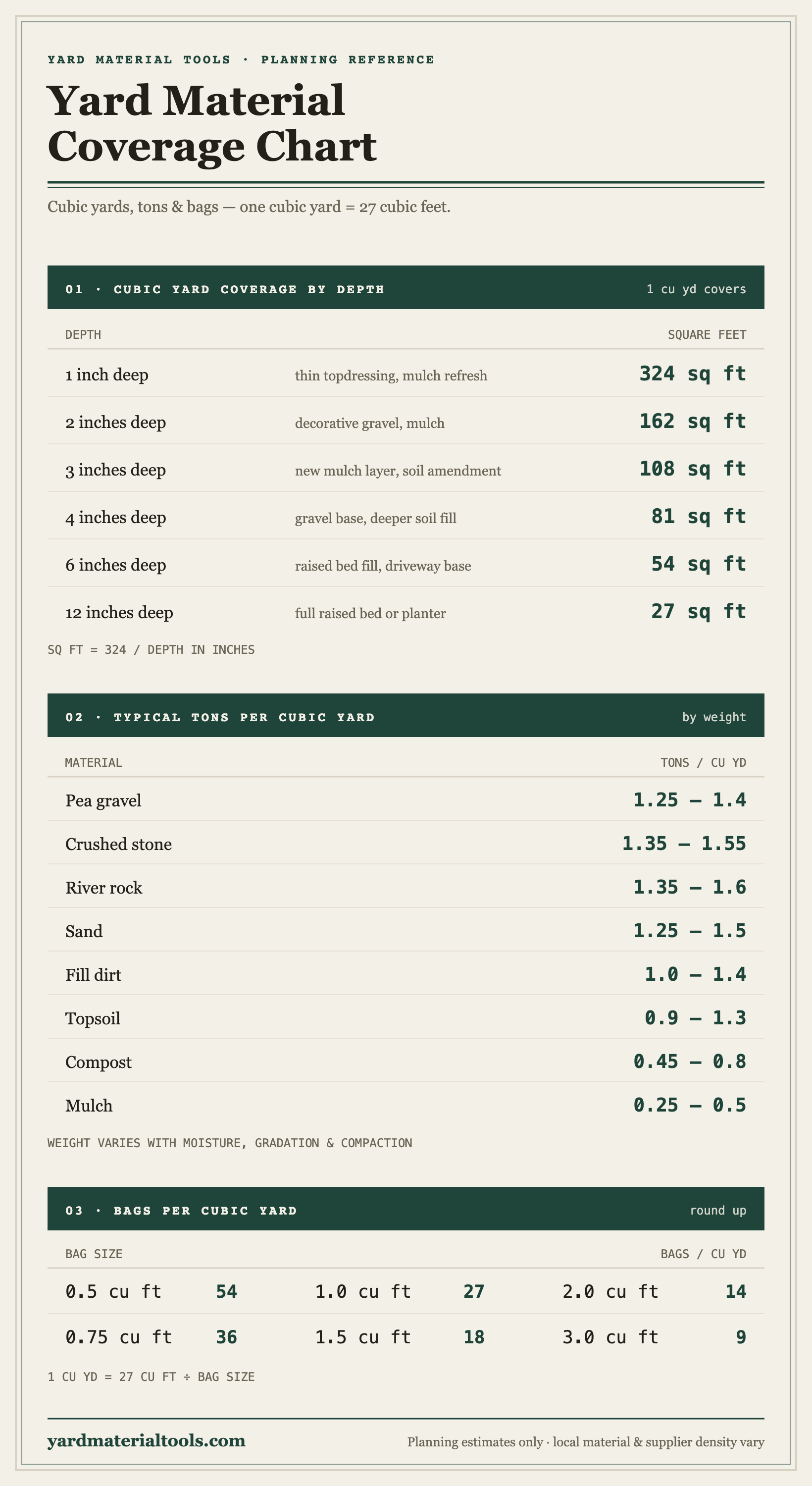
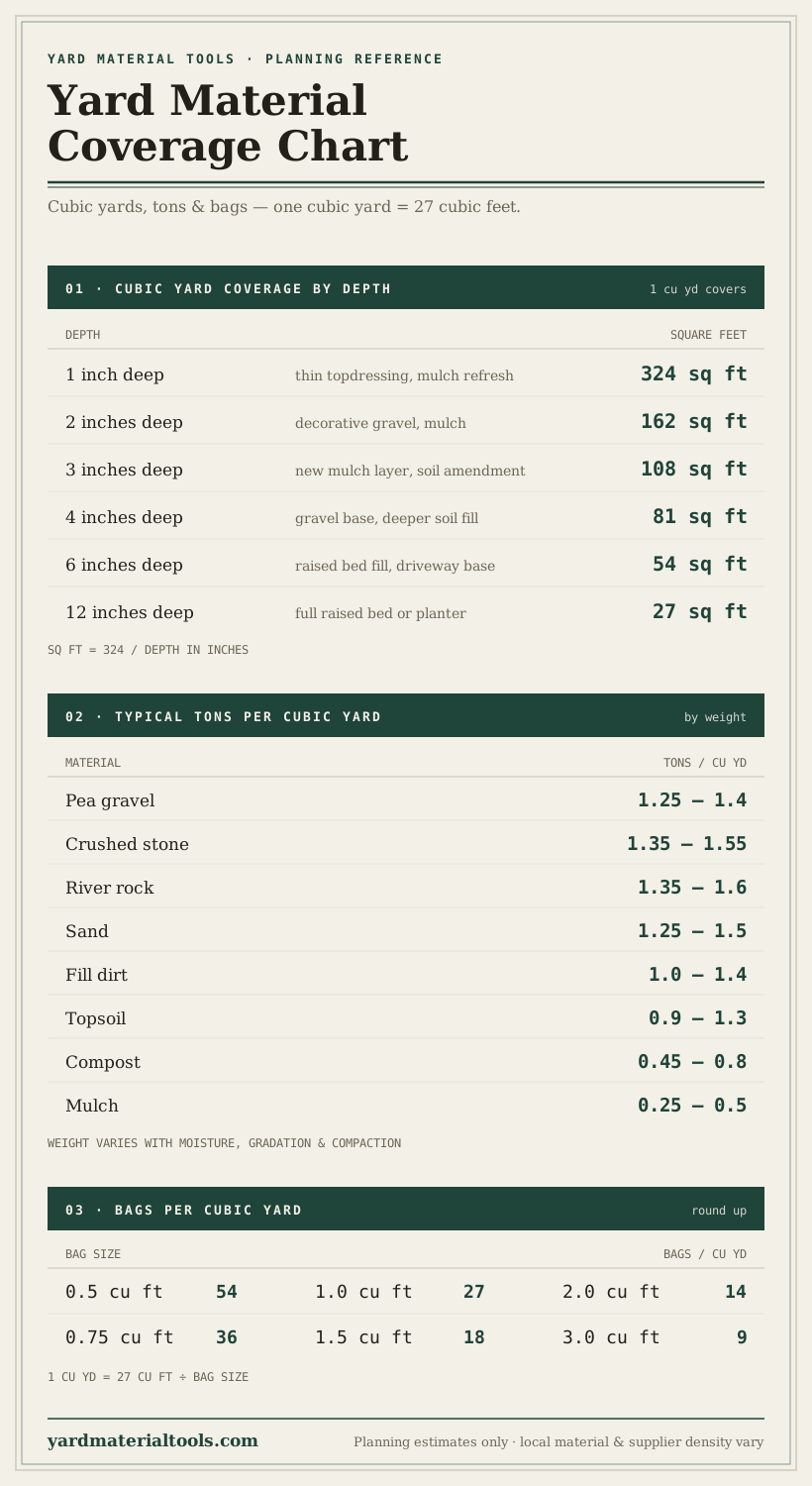
One cubic yard is 27 cubic feet (3 ft x 3 ft x 3 ft). It covers 324 sq ft at 1 in, 162 at 2 in, 108 at 3 in, or 81 at 4 in.
How big is a cubic yard?
- Volume
- 27 cubic feet
- Equal-sided box
- 3 ft x 3 ft x 3 ft
- Coverage at 3 inches
- 108 square feet
One cubic yard always equals 27 cubic feet.
A box with three-foot sides holds exactly one cubic yard.
Coverage before waste, compaction, or settling.
A delivered pile will not form a perfect cube, so its visible height and footprint vary. Use volume and finished depth, not pile shape, when planning an order.
How much area does one cubic yard cover?
Cubic yard coverage by depth
| Depth | 1 cubic yard covers | Common planning use |
|---|---|---|
| 1 in | 324 sq ft | Light mulch refresh, thin topdressing |
| 2 in | 162 sq ft | Decorative mulch, pea gravel over a prepared bed |
| 3 in | 108 sq ft | New mulch layer, garden soil amendment, shallow stone cover |
| 4 in | 81 sq ft | Gravel base, deeper soil fill, compacted pathway base |
| 6 in | 54 sq ft | Raised bed fill, driveway base correction, deeper leveling |
| 12 in | 27 sq ft | Full raised bed or planter fill |
Formula: square feet covered by 1 cubic yard = 324 divided by depth in inches. To estimate cubic yards from a measured area, multiply square feet by depth in inches, then divide by 324.
How cubic yard coverage changes by depth
Most yard projects start with one question: how far will a cubic yard go? A cubic yard is 27 cubic feet, so the coverage depends entirely on depth. Spread the same yard one inch deep and it covers 324 square feet. Spread it four inches deep and it covers only 81 square feet. That is why two projects with the same footprint can need very different orders when one is a light mulch refresh and the other is a compacted gravel base.
This page collects the common conversions in one place so supplier pages, DIY guides, and homeowner notes can link to a stable reference. Use the tables for a quick check, then open the matching calculator when you need waste, bag size, density, or a printable material list.
Save or embed the coverage chart
The same numbers in one printable, shareable image. Download it as a PNG for notes and social posts, a PDF to print, or a Markdown table to drop into your own docs — or embed it on a supplier page, DIY post, or material checklist. The embed code links back here so readers can open the full reference and the calculators.
Typical tons per cubic yard
| Material | Typical tons per cubic yard | Planning note |
|---|---|---|
| Pea gravel | 1.25-1.4 tons | Rounded stone, often used for paths and patios |
| Crushed stone | 1.35-1.55 tons | Angular aggregate; compacted base may settle |
| River rock | 1.35-1.6 tons | Varies by stone size and moisture |
| Topsoil | 0.9-1.3 tons | Moisture changes weight quickly |
| Compost | 0.45-0.8 tons | Usually lighter than mineral soil |
| Mulch | 0.25-0.5 tons | Often sold by cubic yard or bag instead of ton |
| Sand | 1.25-1.5 tons | Bedding and fill sand vary by moisture and gradation |
| Fill dirt | 1.0-1.4 tons | Screened and unscreened dirt can differ |
Weight is not a fixed promise. Stone type, gradation, moisture, and compaction change the final tons. If your supplier sells by weight, ask for their current tons-per-yard figure and use the cubic yards to tons calculator to replace the planning density. For a compacted path, use the decomposed granite calculator to include compaction and waste separately.
Bags per cubic yard
| Bag size | Bags for 1 cubic yard | Common material |
|---|---|---|
| 0.5 cu ft | 54 bags | Small soil or amendment bags |
| 0.75 cu ft | 36 bags | Small mulch or soil bags |
| 1 cu ft | 27 bags | Soil, compost, rubber mulch |
| 1.5 cu ft | 18 bags | Mulch and garden soil |
| 2 cu ft | 14 bags | Common mulch bag size, rounded up |
| 3 cu ft | 9 bags | Large mulch and soil bags |
Bag counts are rounded up because stores do not sell partial bags. Compare bag pricing with bulk delivery once the estimate gets close to one cubic yard.
How to use the chart with calculators
Start with the coverage table when you want a quick order check. If a supplier page says one cubic yard of mulch covers about 100 square feet at 3 inches, you can see that the figure is in the right range because the table shows 108 square feet. If a driveway base needs four inches of crushed stone, one cubic yard only covers about 81 square feet before waste or compaction.
Then switch to the calculator that matches the buying task. Convert a cubic-yard estimate into yards, tons, or bags with the pea gravel calculator, convert a known volume into store packages with the bags per cubic yard calculator, size washed stone, pipe, and fabric with the French drain gravel calculator, or coordinate pavers, base, and sand with the paver patio project calculator. Each calculator adds its own waste or compaction assumptions, so the reference chart does not have to hide project-specific choices inside a generic coverage number.
Use the matching calculator
Reference note for suppliers and guides
If you maintain a landscape supply page, DIY guide, or material ordering checklist, you can cite this page as a general coverage reference for cubic yards, tons, and bags. Link text such as yard material coverage chart, cubic yard coverage chart, or Yard Material Tools coverage chart keeps the reference clear without promising that one density works for every supplier.
For a more specific project, link directly to a calculator page instead. A reader planning a pea gravel patio needs different density and depth assumptions than a reader filling a raised bed. The chart is the quick reference; the calculator is the project worksheet.
The machine-readable coverage, density, and bag-conversion tables are preserved as version 1.1.0 on Zenodo. Cite the version DOI when reproducibility matters; use the concept DOI when referring to the dataset across all future versions.
Version DOI: 10.5281/zenodo.21370505
Concept DOI: 10.5281/zenodo.21370504
Coverage chart FAQ
How much area does one cubic yard cover?
One cubic yard covers 324 square feet at 1 inch deep, 162 square feet at 2 inches deep, 108 square feet at 3 inches deep, or 81 square feet at 4 inches deep. Divide 324 by the depth in inches to estimate square feet per cubic yard.
How do I convert square feet and depth to cubic yards?
Multiply square feet by depth in inches, then divide by 324. For example, 240 square feet at 3 inches deep is 240 times 3 divided by 324, or about 2.22 cubic yards before waste.
How many tons are in a cubic yard?
Tons per cubic yard depend on the material. Gravel, crushed stone, river rock, and sand are often around 1.25 to 1.6 tons per cubic yard, while mulch and compost are much lighter. Confirm the density with the supplier when ordering by weight.
How many bags equal one cubic yard?
A cubic yard is 27 cubic feet. That equals 27 one-cubic-foot bags, 18 bags at 1.5 cubic feet, about 14 bags at 2 cubic feet, or 9 bags at 3 cubic feet. Always round bag counts up.
Should I add waste to a coverage estimate?
Usually yes. A small waste allowance helps cover uneven ground, shape loss, spillage, compaction, and settling. The amount depends on the material and project shape, so use the chart as a planning estimate and adjust for local conditions.
Printable worksheet reminder
For a printed takeoff, open the calculator for your material and use the print button on the result card. The printout includes the quantity, bag count, waste setting, density, and material list. This chart is meant for quick comparison and citation; the calculator printout is the better record to bring to a supplier.